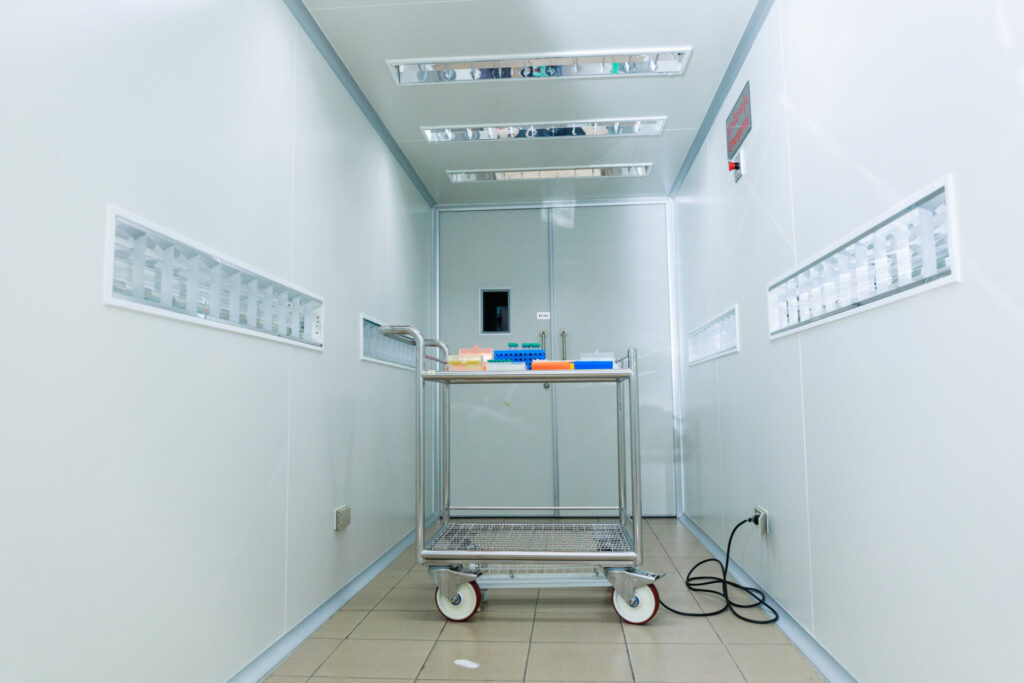
Previous Next The animal facility is located at the Chulabhorn Research Institute. The facility is housed in one separate 5-storey building that is connected to the Biomedical Research Building on the Mezzanine and 2nd floors at the ends of 2 wings. The total area is approximately 2,660 square meters. The animal facility is a clean conventional facility. There are separate corridors designated as clean or dirty, and a 1-way workflow through the animal rooms. The ground floor is an open lobby external to the building. The Mezzanine floor is a support area for the building that contains the cage wash area, feed and bedding storage areas, drinking water preparation area, animal receiving room, and laundry area. It also houses the air handling units that serve the Mezzanine floor. The second floor is for general animal research. The third floor is non- clinical GLP study facility. The fourth floor is for inhalation toxicology. The fifth floor houses the air handling units that serve the second, third and fourth floors. Access to the building is restricted to only those who are conducting work in the LAC, which includes LAC personnel, researchers and maintenance personnel.
The CRI Laboratory Animal Center (LAC) has primary responsibility for the day-to-day management of the research animal facility, as well as for implementation of CRI’s ACUP. It is headed by the Director of LAC, a qualified veterinarian with a wealth of experience in care and management of laboratory animal breeding and laboratory animal medicine, and staffed with full-time attending veterinarian, clinical veterinarian, facility engineer, animal technician and animal care workers, all of whom have been appropriately trained in their areas of responsibility and who undergo continual training as necessary according to CRI policy. MISSION Laboratory animal management and husbandry Veterinary preventive medicine and medical care Consultation pertaining to animal care and use, as well as veterinary medical issues in animal use protocol development Support for compliance with animal use protocols carried out in its facilities Training in the care and use of laboratory animals Reporting of requirements to the Institute Animal Care and Use Committee (IACUC)
Three international Courses on Occupational Health and Safety and Environmental Health are planned for summer 2017: “Global Occupational and Environmental Determinants of Diseases: a multidisciplinary approach for prevention“, July 10-14, at the University of Brescia, Italy; “Advanced International Training Course in Occupational and Environmental Health“, July 17-21, at the Chulabhorn Research Institute in Bangkok, Thailand; “Teaching interventions crossing borders“, August 21-September 1, at the Ludwig Maximillian University of Munich, Germany. In addition to high-quality, hands-on training in occupational health and safety, these courses provide unique opportunities for networking among OEH professionals from both high-income countries and low- and middle-income countries and for developing multi-national approaches to continuing education that extend beyond the courses. Students and faculty attending the three courses are encouraged to provide information about occupational and environmental health in their countries including such aspects as OHS services coverage and organization; workers’ benefits and compensation; ratification and implementation of ILO and WHO policies; preventive interventions in environmental health; and remediation of hazardous waste sites. To provide an opportunity for young OEH professionals to publish their work in a peer-reviewed journal, students and faculty participating in the courses are invited to submit publications in a special issue of the Annals of Global Health that will be specifically dedicated to Occupational and Environmental Global Health and guest edited by the Directors...
Development of a GNA-lectin based immunochromatographic test for rapid diagnosis in human penicilliosis marneffeiPenicillium marneffei is classified as an important emerging opportunistic fungal infection. It has been recently renamed as Talaromyces marneffei. It is the most prevalent systemic mycotic infection in patients infected with human immunodeficiency virus (HIV). This infection is endemic in tropical Asia including Thailand, northeastern India, southern China, Hong Kong, Vietnam and Taiwan. The microorganism is the only known temperature-dependent dimorphic fungus of the genus Penicillium.In the purpose of this study, a novel sandwich ICT for screening P. marneffei antigen in urine and/or serum samples will be developed. The monoclonal anti-P. marneffei antigen gold conjugate will be used as specific signal developing agent and Galanthus nivalis agglutinin (GNA), (or polyclonal anti- P. marneffei antigen) immobilized at test line zone will be used as capturing molecule acting as polyclonal anti-terminal mannose. The diagnostic performance of the novel sandwich ICT strip will be evaluated in comparison to that of the hemoculture-confirmed penicilliosis marneffei which is used as the gold standard laboratory diagnosis of penicilliosis marneffei.
Name: Dr. Kwanrawee Sirikanchana, Ph.D.Office address: Laboratory of Biotechnology54 Kamphaeng Phet 6 Talat Bang Khen, Lak Si, Bangkok 10210, ThailandTel: +66 25530 8555 (ext. 3255)E-mail:[email protected] Scientist IIResearch Experience (Specialties) Microbial source tracking, disinfection, environmental microbiology, water and wastewater treatment, water quality Antimicrobial resistance Education 1996-2000 B.E. (Environmental Engineering) with first class honours, Chulalongkorn University, Thailand 2001-2003 M.S. (Environmental Engineering) University of Illinois at Urbana-Champaign, USA 2003-2007 Ph.D. (Environmental Engineering) University of Illinois at Urbana-Champaign, USA 2007-2009 Postdoctoral Associate, Department of Civil and Environmental Engineering, University of California Davis, USA (with Prof. Stefan Wuertz) Awards 1996, 1998, 1999 Best Undergraduate Students Award, Faculty of Engineering, Chulalongkorn University 1999 Best Engineering Student’s Award, The Engineering Institute of Thailand under H.M. the King’s Patronage 1999 Best Engineering Student’s Award, Siam Cement (Public) Co., Ltd. 2000 Gold Medal Award, Faculty of Engineering, Chulalongkorn University 2001-2007 Graduate Study Fellowship, Royal Thai Government 2002, 2003, 2005, 2006 Racheff Student Travel Fund, University of Illinois at UrbanaChampaign, USA 2009 New Faces in Civil Engineering, American Society of Civil Engineers, USA 2010 Thailand Thesis Award, National Research Council of Thailand 2015 IWA-HRWM Willie Grabow Young Investigator Award, International Water Association, United Kingdom 2016 Young Alumnus Achievement Award, Department of Civil and Environmental Engineering, University of Illinois at Urbana-Champaign, USA 2016 Kurita Water and Environmental Foundation – Asian Institute...
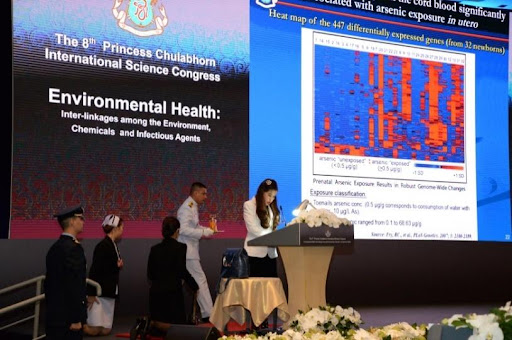
The 8th Princess Chulabhorn International Science Congress was held during the week of November 13-17, 2016 to commemoratethe seventieth anniversary of the accession to the throne of His Majesty King Bhumibol Adulyadej and the seventh cycle (84 years) birthday of Her Majesty Queen Sirikit. The theme of the Congress, “Environmental Health: Inter-linkages among the Environment, Chemicals and Infectious Agents”, is in line with the views of Her Royal Highness Princess Chulabhorn, who has consistently emphasized the importance of research and development in environmental health, which can integrate the fields of environmental science, chemical safety and infectious agents. The Congress included a keynote lecture, a Nobel laureate lecture, plenary sessions, symposia, and a roundtable discussion. There were also 16 platform presentations and 159 poster presentations displaying research conducted by congress participants. The Congress involved a total of 75 invited speakers from 20 countries and over 700 participants from 29 countries. The Opening Keynote Lecture was given by Her Royal Highness Princess Chulabhorn on the topic of, “Environmental Health: The Significance of Early Life Chemical Exposures”. Her Royal Highness provided a general overview of the public health problems facing the developing world that are a major obstacle to sustainable development because they impact not only the health of the present generations but also future ones. She provided a specific example on arsenic...
Name: Mrs. Sujunya Rueangveerayut Office address: Laboratory of Biotechnology 54 Kamphaeng Phet 6 Talat Bang Khen, Lak Si, Bangkok 10210, Thailand Tel: +66 25530 8555 (ext. 3032, 3033) E-mail: Research Scientist Research Experience (Specialties) Plant Tissue Culture (special in floriculture and orchids), Physiology and plantation of floriculture,ornamental and herbal plants Education 1988-1992 B. Sc. (Agriculture) Kasetsart University 1992-1995 M. Sc. (Agriculture) Kasetsart University Publications 1. Bhinija, K., Chokchaichamnankit, D., Srisonsap, C., Svasti, J., Ruengverayut, S., Huehne, P.S. 2010. Opitimize protocol for protein extraction from orchid plants. The 5th Annual Symposium of Protein Society of Thailand ‘From the basic approaches to modern technologies’, June 23-25, 2010. Chulabhorn Research Institute Conference Center, Bangkok, Thailand. (National Poster)2. Bhinija, K. Lertviriyakul, B., Ruengverayut, S., Khanthong, S., Huehne, P.S. 2007. Diversity of Chloroplast Genetics in Epidendrodae Orchids. The Sixth Princess Chulabhorn International Science Congress, held on November 26-29, 2007. Bangkok, Thailand. (International-Poster) 3. Bhinija K., Chokchaichamnankit, D.,Phiphobmongkol, C. , Ruengverayut, S. and Huehne, P.S. 2008. Characterization of proteins in leaf of wild orchid,Bulbophyllum blepharisters Rchb.f. The Third Annual Symposium of Protein Society of Thailand Frontier in Protein Research,28-29 August 2008. 4. Bhinija K., Ruengverayut, S., Loprasert, S., Huehne, P.S. 2004 Enzymatic digestion use to improve squash technique in chromosome study of Thai wild orchids. The Fifth Princess Chulabhorn International Science Congress Evolving Genetics and Its...
Name: Ms. Kisana Bhinija Office address: Laboratory of Biotechnology 54 Kamphaeng Phet 6 Talat Bang Khen, Lak Si, Bangkok 10210, Thailand Tel: +66 25530 8555 (ext. 3033, 3249) E-mail: Position: Research Scientist I Research Experience (Specialties) Plant tissue culture, Plant cytogenetics, Plant proteomic Education 1992-1995 B. Sc. (Agriculture) Khonkean University 1997-2002 M. Sc. (Genentics) Kasetsart University Publications Patipipat, P., Bhinija, K., Wongkhamprai, B., Hunhne, P. S. 2014. Molecular cloning of arsenate reductase and phytochelatin synthase genes related to arsenic response in Oryza sativa L. ssp. indica cv. Khao Dawk Mali 105. Thai J. Genet. 7(1) : 41–50. Mohamad, Z. A., Chokchaichamnankit, D., Bhinija, K., Paricharttanakul, N. M., Svasti, J., Huehne, P. S., Srisomsap, C. 2013. Proteome level changes in the root of Brassica alboglabra induced by alachlor herbicide. African Journal of Biotechnology. 12(20) : 2840-2849. Huehne, P. S., Bhinija, K. 2012. Application of cryoprotectants to improve low temperature storage survival of orchid seeds. Scientia Horticulturae. 135(1) : 186-193. Mohamad, Z. A., Chokchaichamnankit, D., Bhinija, K., Paricharttanakul, N. M., Svasti, J., Huehne, P. S., Srisomsap, C. 2011. Proteomic analysis of Alboglabra leaves during growth. Jiomic 1(1): 102-107. Lertwiriyawong, B., Bhinija K., Huehne., P.S. 2010. Sequence Analysis of the 16SrRNA-rps12 Inverted Repeat Region in Chloroplast DNA of Dendrobium orchids. Kasetsart J. Nat. Sci. 45 : 45-472. Teerarak, M., Bhinija, K.,Thitavasanta, S., Laosinwattana,...
Name: Dr. Panu Ruangjan Office address: Laboratory of Biotechnology 54 Kamphaeng Phet 6 Talat Bang Khen, Lak Si, Bangkok 10210, Thailand Tel: +66 25530 8555 (ext. 3033) E-mail: [email protected] Research Scientist Research Experience (Specialties) Plant Breeding, Plant Molecular Biology Education 1981-1985 B. Sc (Horticulture) Kasetsart University 1986-1990 M. Sc (Horticulture) Kasetsart University 2001-2005 Ph. D (Molecular Genetic and Genetic Engineering Mahidol University Awards 2001-2005 Scholarship from the Civil Service Commission Training Workshop 2003 Workshop on Genetic Diversity Analysis Using DNA Marker during May15 – 19 at Department of Genetic, Kasetsart University 2003 Workshop on Linkage Map Construction and Quantitative Trait Loci (QTL) Analysis during May 22 – 26 at Rice Gene Discovery Unit, National Center for Genetic Engineering and Biotechnology 2007 Workshop on International Workshop on Ornamental Plants during January 8 – 11 at Lotus Hotel Pang Suan Kaew 2010 Workshop on Biotechnology Methods for Gynogenesis of Cucumber and Androgenesis of Pepper during March 17 – 19 at National Center for Genetic Engineering and Biotechnology, Kamphaeng Saen Unit Publications 1997 D. Evenor, H. Lilien-Kipnis, A.A. Watad and P. Raungjan, 1997. Micropropagation of ornamental Allium aflatunense and ampeloprasum. ISHS Acta Horticulturae 447, III International Symposium on In Vitro Culture and Horticulturae Breeding, Jerusalem, Israel, p. 135-138 (Poster Presentation) 2002 Ruangjan, P., M. Juricek, S. Panyim. and S. Kerdbandit, 2002. Analysis of...
Name: Mister Weerachai Tanboon Office address: Research Laboratory of Biotechnology, Chulabhorn Research Institute, 54 Kamphaeng Phet 6 Talat Bang Khen, Lak Si, Bangkok 10210, Thailand Tel: +662-5538555 (ext. 8556) (office) Positions: Research Scientist, Research Laboratory of Biotechnology, Chulabhorn Research Institute E-mail: [email protected] Research Interests Molecular microbiology Education and Degrees M.B.A. (General Management), Chandrakasem Rajabhat University, Thailand, 2008 B.Sc. (Microbiology), King Mongkut’s University of Technology, Thailand, 2001 Publications Tanboon, W., Chuchue, T., Vattanaviboon, P., & Mongkolsuk, S. (2009). Inactivation of thioredoxin-like gene alters oxidative stress resistance and reduces cytochrome c oxidase activity in Agrobacterium tumefaciens. FEMS Microbiology Letters, 295(1), 110-116. doi:10.1111/j.1574-6968.2009.01591.x Vattanaviboon, P., Tanboon, W., & Mongkolsuk, S. (2007). Physiological and expression analyses of Agrobacterium tumefaciens trxA, encoding thioredoxin. Journal of Bacteriology, 189(17), 6477-6481. doi:10.1128/JB.00623-07 Chuchue, T., Tanboon, W., Prapagdee, B., Dubbs, J. M., Vattanaviboon, P., & Mongkolsuk, S. (2006). ohrR and ohr are the primary sensor/regulator and protective genes against organic hydroperoxide stress in Agrobacterium tumefaciens. Journal of Bacteriology, 188(3), 842-851. doi:10.1128/JB.188.3.842-851.2006
Name: Miss Jintana Duang-nkern Office address: Laboratory of Biotechnology 54 Kamphaeng Phet 6 Talat Bang Khen, Lak Si, Bangkok 10210, Thailand Tel: +66 25530 8555 (ext. 3261) E-mail: Position: Research Scientist I Research Experience (Specialties) Molecular Genetics and Molecular Biochemistry in Microbiology 2011-Present Chulabhorn Research Institute, Laboratory of Biotechnology in Projects: -Molecular characterization of the repair systems that protect pathogenic bacteria from toxicants-induced DNA damages. -Analysis of multi-drug and stress resistance mechanisms in soil and pathogenic bacteria. -Identification of novel genes that involve in bacterial pathogenesis 2008–2010 Mahidol University, Faculty of Science and Department of Biotechnology Research Project: Characterization of the nfuA, encoding an iron sulfur scaffold protein in Pseudomonas aeruginosa 2006 –2007 Kasertsart University, Faculty of Science and Department of Genetics Research Project: Indentification Hybrid Mushroom of Lentinula edodes, Lentinus squarrosulus and Lentinus polychrous Using AFLP Techinque 2006 National Center for Genetic Engineering and Biotechnology (BIOTEC), Protein-Ligand Engineering and Molecular Biology Laboratory Topic: Cloning of pvPPPK-DHPS into pPICZA for protein expression in yeast Pichia sp. and Expression and purification of peptides from Pvpppk-dhps for generation of antibody production. Education 2008-2010 M.Sc. in Biotechnology Mahidol University 2003-2006 B.Sc. in Biology (Genetics) Kasetsart University Awards 2006 Second Class Honor from Kasetsart University 2005 Certificate of Accomplishment for The Molecular Biology Training at National Center for Genetic Engineering and Biotechnology (BIOTEC), National...
We use cookies to improve performance. and good experience using your website. You can study details at Cookies policy and can manage your own privacy by clicking on Settings
Necessary cookies are absolutely essential for the website to function properly. These cookies ensure basic functionalities and security features of the website, anonymously.
Analytics
Analytical cookies are used to understand how visitors interact with the website. These cookies help provide information on metrics the number of visitors, bounce rate, traffic source, etc.